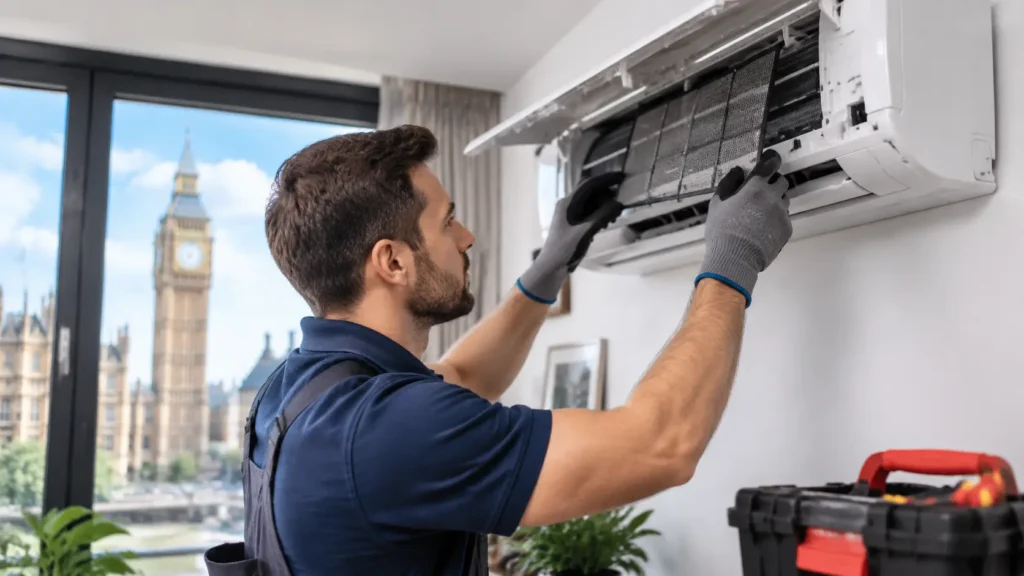
When your air conditioning suddenly stops cooling, starts leaking water or makes unusual noises, it can quickly become more than a minor inconvenience. In a home, it affects your comfort. In an office, shop or commercial property, it can disrupt everyday operations.
The good news is that not every air conditioning problem requires an expensive replacement. Some faults are caused by blocked filters, drainage issues or incorrect settings, while others involve electrical components, refrigerant circuits or the compressor.
If you are looking for reliable air conditioning repair in London, understanding what might be wrong with your system is a useful first step. This guide explains the most common faults, what you can safely check yourself, when professional attention is necessary and what to consider before arranging a repair.
What Are the Most Common Air Conditioning Problems?
Air conditioning systems can develop different faults depending on their age, installation quality, usage and maintenance history. However, certain problems appear more frequently than others.
Understanding the symptoms can help you explain the issue to an engineer and avoid unnecessary troubleshooting.
1. Air Conditioner Not Cooling Properly
One of the most common reasons people request air conditioning repair is that the unit runs but does not produce enough cool air.
You might notice that:
-
The airflow feels weaker than usual.
-
The room takes much longer to reach the desired temperature.
-
The air coming from the indoor unit is not sufficiently cold.
-
The system runs continuously without improving comfort.
Several issues can cause this problem:
Dirty air filters: Dust and debris restrict airflow through the indoor unit. This can reduce cooling performance and place additional strain on the system.
Low refrigerant levels: Refrigerant circulates through the system to transfer heat. If the level is low because of a leak, cooling performance can deteriorate.
Outdoor unit problems: Dirt, restricted airflow or a faulty component in the outdoor condenser can prevent the system from releasing heat effectively.
Incorrect thermostat settings: Sometimes the issue is simpler than expected. An incorrect operating mode, temperature setting or control configuration may prevent the unit from cooling as intended.
A technician should check airflow, operating temperatures, electrical components and refrigerant conditions before recommending a repair.
2. Water Leaking From the Indoor Unit
Water dripping from an indoor air conditioning unit should not be ignored.
Air conditioning systems naturally produce condensation as they remove moisture from the air. This water should travel through a drainage pipe and discharge safely outside or into an appropriate drainage point.
Leaks can occur when:
-
The condensate drain becomes blocked.
-
The drainage pipe is damaged or disconnected.
-
The drain pan is cracked or incorrectly positioned.
-
Ice forms on the evaporator coil and later melts.
-
The system has an installation or drainage problem.
A blocked drain is particularly common in systems that have not received regular maintenance.
What should you do?
Turn off the unit if water is leaking significantly, especially near electrical equipment. Avoid opening electrical panels or dismantling the indoor unit yourself.
A qualified engineer can inspect the drainage system, identify the cause and restore proper water removal.
3. Air Conditioner Making Strange Noises
An air conditioning unit should produce a relatively consistent operating sound. Sudden or unusual noises may indicate a mechanical or electrical problem.
Different sounds can suggest different issues:
| Noise | Possible cause |
|---|---|
| Rattling | Loose panels or components |
| Buzzing | Electrical or mechanical fault |
| Grinding | Worn or damaged moving parts |
| Hissing | Possible refrigerant leak or airflow issue |
| Clicking repeatedly | Control or electrical component problem |
These sounds are clues rather than definitive diagnoses.
For example, a loose external panel may create a rattling noise, whereas grinding from a fan motor could indicate a more serious mechanical fault.
If you notice a burning smell, repeated electrical clicking or unusually loud mechanical noises, switch off the system and arrange a professional inspection.
4. Air Conditioner Not Turning On
An air conditioning unit that refuses to start may have an electrical, control or power supply problem.
Before arranging a repair, you can safely check:
-
Whether the main power supply is switched on.
-
Whether the remote control has working batteries.
-
Whether the thermostat is configured correctly.
-
Whether the circuit breaker has tripped.
If the circuit breaker repeatedly trips, do not keep resetting it. This may indicate an underlying electrical fault.
An engineer can inspect the control board, wiring, electrical connections and other components to establish why the system is not starting.
5. Bad Smells Coming From the Air Conditioner
Unpleasant smells can make an otherwise functioning air conditioning system uncomfortable to use.
Common causes include:
-
Dust and dirt accumulating inside the unit.
-
Moisture remaining in the drainage system.
-
Build-up of contaminants around the evaporator coil.
-
Dirty filters.
-
Microbial growth in damp areas.
A musty smell may indicate moisture-related contamination, while a burning smell can signal a potentially dangerous electrical or mechanical problem.
Do not assume every unusual smell can be solved by changing the filter. The source should be identified before the system is returned to normal operation.
When Should You Call an Air Conditioning Repair Engineer?
Not every issue requires an emergency visit. However, certain symptoms should be treated seriously.
The following guide can help you decide what to do.
| Problem | Recommended action |
|---|---|
| Slightly reduced airflow | Check the accessible filter |
| Incorrect temperature setting | Check thermostat and operating mode |
| Persistent poor cooling | Arrange professional inspection |
| Water leaking indoors | Switch off and arrange inspection |
| Repeated circuit breaker trips | Stop using the system and call an engineer |
| Burning smell | Switch off power if safe and seek urgent assistance |
| Loud grinding or unusual mechanical noise | Stop operation and arrange inspection |
One important distinction is the difference between a performance problem and a safety problem.
If your system is simply taking longer to cool a room, a scheduled inspection may be appropriate. If you notice burning smells, damaged electrical cables or repeated breaker trips, continuing to operate the unit could make the situation worse.
Manufacturer guidance also advises stopping operation and contacting a service professional when symptoms such as burning smells, unusual sounds or indoor water leaks occur.
What Is Included in Professional Air Conditioning Repair?
A proper repair should start with identifying the underlying fault rather than immediately replacing parts.
The exact process depends on the system and the reported symptoms, but a professional inspection may include several stages.
1. Initial Inspection and Fault Diagnosis
The engineer reviews the reported problem and examines the system.
This may involve checking:
-
Indoor and outdoor units.
-
Thermostat and control settings.
-
Air filters and airflow.
-
Electrical connections.
-
Drainage components.
-
Error codes and system operating conditions.
The objective is to identify the actual cause of the fault.
2. Electrical and Mechanical Checks
If the initial inspection indicates an electrical or mechanical issue, the engineer may test relevant components.
These can include:
-
Fan motors.
-
Capacitors.
-
Contactors.
-
Control boards.
-
Sensors.
-
Electrical connections.
The components tested depend on the system design and the symptoms.
3. Refrigerant Circuit Inspection
Refrigerant is essential for heat transfer within an air conditioning system.
If the system is undercharged, it may struggle to deliver the expected cooling performance. However, low refrigerant should not automatically be treated as a normal maintenance issue.
A qualified engineer should investigate whether there is a leak and determine why the refrigerant level is low.
Refrigerant handling is regulated in the UK. Individuals working on relevant stationary air conditioning systems must hold the appropriate qualifications, and companies servicing equipment containing F-gas for other operators must meet applicable certification requirements.
4. Repair, Testing and Performance Checks
Once the fault has been identified, the engineer can explain the recommended repair and any associated costs.
After the work is completed, the system should be tested to confirm that the original problem has been addressed and that it is operating correctly.
This final stage matters. Replacing a component without checking the system’s overall operation may leave an underlying problem unresolved.
How Much Does Air Conditioning Repair Cost in London?
The cost of air conditioning repair in London depends on the type of system, the nature of the fault and the parts required.
There is no single price that applies to every repair.
For example, resolving a blocked condensate drain is generally a different job from diagnosing a faulty compressor or repairing a refrigerant leak.
The following factors influence the final quotation:
Type of air conditioning system
A domestic wall-mounted split system usually has a different repair scope from a multi-split installation or a commercial HVAC system.
Nature of the fault
A minor drainage problem may require less work than an electrical control fault or a major mechanical failure.
Replacement parts
The availability, manufacturer and model of the required component can affect the price.
Access to equipment
Outdoor units installed on rooftops, high walls or difficult-to-reach locations may require additional access arrangements.
Emergency attendance
Out-of-hours or urgent appointments may have different call-out charges.
Before approving a repair, ask for a clear explanation of the fault, the proposed work, the parts required and whether labour and call-out charges are included.
This makes it easier to compare quotations fairly.
Air Conditioning Repair for Different Types of Systems
Not all air conditioning systems work in the same way. The repair approach depends on the equipment installed, its capacity and the way the indoor and outdoor units are connected.
Split Air Conditioning Systems
Split systems are commonly installed in homes, apartments and smaller commercial spaces.
They consist of an indoor unit and an outdoor unit connected by refrigerant pipework and electrical connections.
Typical repair requirements include:
-
Indoor fan motor faults.
-
Blocked condensate drainage.
-
Refrigerant leaks.
-
Sensor problems.
-
Outdoor condenser issues.
-
Remote control and communication faults.
Multi-Split Air Conditioning Systems
Multi-split systems connect several indoor units to a shared outdoor unit.
They are useful when different rooms need independent temperature control without installing a separate outdoor unit for every room.
When one indoor unit stops working, the problem may be isolated to that unit. However, faults involving the shared outdoor equipment or refrigerant circuit can affect several rooms.
A proper diagnosis should establish whether the issue is local to one indoor unit or affects the wider system.
Commercial Air Conditioning Systems
Commercial properties often use more complex air conditioning arrangements to maintain comfortable temperatures across larger areas.
These may include:
-
Cassette air conditioning units.
-
Ducted air conditioning systems.
-
Ceiling-mounted units.
-
VRF and VRV systems.
-
Larger centralised HVAC installations.
Commercial repair work may require additional planning because a fault can affect multiple rooms, employees, customers or business operations.
For offices, restaurants, retail premises and other commercial environments, identifying the cause quickly can help minimise disruption.
Should You Repair or Replace Your Air Conditioner?
This is one of the most important decisions when an air conditioning system develops a significant fault.
Repairing an existing unit is not always the cheapest long-term option. Equally, replacing an entire system because of a relatively minor problem can result in unnecessary expense.
Consider the following factors before making a decision.
| Factor | Repair may be suitable | Replacement may be worth considering |
|---|---|---|
| System age | Relatively new equipment | Older equipment |
| Fault | Minor component failure | Major compressor or repeated faults |
| Repair cost | Reasonable compared with replacement | High proportion of replacement cost |
| Efficiency | Performs efficiently | Consistently high running costs |
| Parts | Readily available | Difficult to source |
| Reliability | Occasional isolated issue | Frequent breakdowns |
For example, if a relatively new split system develops a drainage problem, repairing it is usually more sensible than replacing the entire installation.
On the other hand, if an older unit has suffered repeated compressor failures, has poor efficiency and requires expensive replacement parts, investing in a new system may make more financial sense.
A professional assessment should compare the expected repair cost with the likely remaining service life and efficiency of the existing equipment.
What Can You Check Before Booking an Air Conditioning Repair?
There are a few basic checks that may help identify simple problems before arranging a service appointment.
These checks should only involve accessible controls and user-serviceable components.
Check the Thermostat Settings
Make sure the system is set to cooling mode rather than heating, fan-only or automatic mode.
Also check that the selected temperature is lower than the current room temperature.
Inspect the Air Filter
A dirty filter can restrict airflow and reduce cooling performance.
If your manufacturer’s instructions allow user access, inspect the filter and clean or replace it as recommended.
Never operate the system without the required filters.
Check the Remote Control
Replace weak batteries and confirm that the remote is communicating with the indoor unit.
If the system has a wall-mounted controller, check its display for error messages.
Make Sure Airflow Is Not Blocked
Check that curtains, furniture or other objects are not obstructing the indoor air outlet or return air intake.
Also make sure the outdoor unit has sufficient space for ventilation.
Look for Visible Water Leaks
If you notice water around the indoor unit, switch the system off and arrange an inspection rather than attempting to dismantle it.
Important: Do not open electrical compartments, work on refrigerant pipes, attempt refrigerant top-ups or dismantle internal mechanical components. These tasks should be handled by appropriately qualified professionals.
Air Conditioning Repair vs Regular Maintenance: What Is the Difference?
Repair and maintenance are closely related, but they serve different purposes.
Air conditioning repair focuses on identifying and correcting an existing fault.
Air conditioning maintenance focuses on keeping the equipment in good condition and identifying developing problems before they cause a breakdown.
| Air conditioning repair | Air conditioning maintenance |
|---|---|
| Usually follows a fault or breakdown | Usually planned in advance |
| Focuses on fixing a specific problem | Focuses on overall system condition |
| May involve replacing faulty parts | May involve cleaning and inspection |
| Aims to restore normal operation | Aims to maintain performance and reliability |
For example, if an indoor unit stops draining condensation, repairing the drainage fault restores its operation.
During routine maintenance, an engineer may also inspect the drain, clean accessible components, check filters and examine the system for signs of deterioration.
The two services complement each other. Regular maintenance cannot prevent every breakdown, but it can help identify certain issues before they become more disruptive.
For larger buildings in England and Wales, there are also statutory air conditioning inspection requirements based on system characteristics and rated output. These inspections are distinct from routine maintenance and repairs.
GOV.UK
Common Air Conditioning Repair Mistakes That Can Cost You More
Some decisions made during an air conditioning breakdown can turn a manageable problem into a more expensive repair.
Here are several mistakes worth avoiding.
1. Assuming Every Cooling Problem Means Low Refrigerant
Poor cooling does not automatically mean that the system needs more refrigerant.
Dirty filters, restricted airflow, sensor faults and condenser problems can produce similar symptoms.
Adding refrigerant without diagnosing the underlying issue may waste money and leave the original fault unresolved.
2. Continuing to Use a Leaking System
Water leaking from an indoor unit should not be ignored.
Apart from damaging ceilings, flooring and nearby furniture, water can create additional risks when it reaches electrical components.
Switch the unit off and arrange an inspection.
3. Repeatedly Resetting a Tripping Circuit Breaker
A circuit breaker is a safety device. If it keeps switching off, there may be an electrical fault or an overloaded circuit.
Repeatedly resetting it without investigating the cause is not a repair strategy.
4. Choosing a Repair Service Based Only on Price
A low quotation may not include diagnosis, replacement parts or follow-up testing.
Before choosing an engineer, check what the quotation covers and whether the company has the appropriate qualifications and certifications for the work involved.
5. Replacing Parts Without Proper Diagnosis
Replacing a compressor, control board or fan motor without identifying the underlying cause can lead to unnecessary expenses.
For example, a compressor problem may be related to another issue within the system. Simply replacing the compressor without investigating the wider fault may not provide a lasting solution.
6. Ignoring the Outdoor Unit
Many people focus only on the indoor unit because that is where they notice the problem.
However, the outdoor unit plays an essential role in releasing heat. Restricted airflow, dirty coils or mechanical faults can affect the performance of the entire system.
A proper inspection should consider both indoor and outdoor equipment.
How to Choose a Reliable Air Conditioning Repair Company in London
Finding an engineer is not difficult. Choosing someone who can diagnose the problem properly and carry out the correct repair is more important.
Before booking an appointment, consider the following:
Check relevant qualifications: If the work involves refrigerant handling, verify that the individual has the appropriate F-gas qualification.
Check company certification: Where required, make sure the company holds the relevant certification to work on stationary equipment containing F-gas.
Ask about experience: Experience with your particular system type can make fault diagnosis more efficient.
Request a clear quotation: You should understand the proposed work, parts, labour and any additional charges before authorising the repair.
Ask about testing: Confirm that the system will be checked after the repair.
Consider emergency availability: If a breakdown affects an important commercial space, knowing whether the company can provide urgent assistance can be valuable.
These checks help you make a more informed decision and reduce the risk of paying for work that does not resolve the actual problem.
Air Conditioning Repair in London: How NBCooling Can Help
If your air conditioning system is not cooling properly, leaking water, making unusual noises or refusing to start, getting the correct diagnosis is the first step towards restoring normal operation.
NBCooling provides air conditioning services in London and surrounding areas, supporting residential and commercial customers with installation, repair and maintenance requirements.
Whether you are experiencing a minor performance issue or a more serious system fault, the right approach begins with understanding the equipment and identifying the underlying cause.
When contacting NBCooling, it helps to provide a few details:
-
Your postcode or property location.
-
Whether the system is domestic or commercial.
-
The make and model, if available.
-
A brief description of the problem.
-
Any error codes displayed by the unit.
-
Whether the problem is intermittent or continuous.
These details can help the team understand your requirements and discuss the appropriate next steps.
Need help with a faulty air conditioning system in London?
Contact NBCooling to discuss your repair requirements and request a quotation.
Frequently Asked Questions About Air Conditioning Repair
How much does air conditioning repair cost in London?
The cost depends on the type of system, the fault, replacement parts and labour. A blocked drain will generally require a different repair process from a compressor or refrigerant circuit fault. Request an individual quotation before approving the work.
Why is my air conditioner running but not cooling?
Common causes include dirty filters, restricted airflow, incorrect thermostat settings, outdoor unit problems or refrigerant leaks. A professional inspection can identify the actual cause.
Can I repair my air conditioner myself?
You can perform basic checks, such as inspecting accessible filters and checking thermostat settings. Electrical repairs, refrigerant handling and internal mechanical work should be carried out by appropriately qualified professionals.
How quickly can an air conditioning system be repaired?
It depends on the fault, engineer availability, access to the equipment and whether replacement parts are required. Some minor problems can be resolved during the initial visit, while more complex repairs may take longer.
Is it better to repair or replace an old air conditioner?
It depends on the equipment’s age, condition, efficiency and repair cost. If the system requires frequent expensive repairs, replacement may be more economical over time.
Does NBCooling provide air conditioning repair in London?
NBCooling serves customers in London and surrounding areas, offering air conditioning repair alongside installation and maintenance services. Contact the team to discuss your requirements and arrange the appropriate service.
Conclusion
An air conditioning breakdown does not always mean that you need a new system. Problems such as blocked filters, drainage faults, electrical issues and refrigerant leaks can often be diagnosed and addressed through professional repair.
The most important step is identifying the actual cause before replacing components or spending money on unnecessary work.
If your system is not cooling properly, leaking water or making unusual noises, start with the basic safety checks and arrange a professional inspection when needed.
For reliable air conditioning repair in London, contact NBCooling to discuss your system, explain the symptoms and request a quotation.