
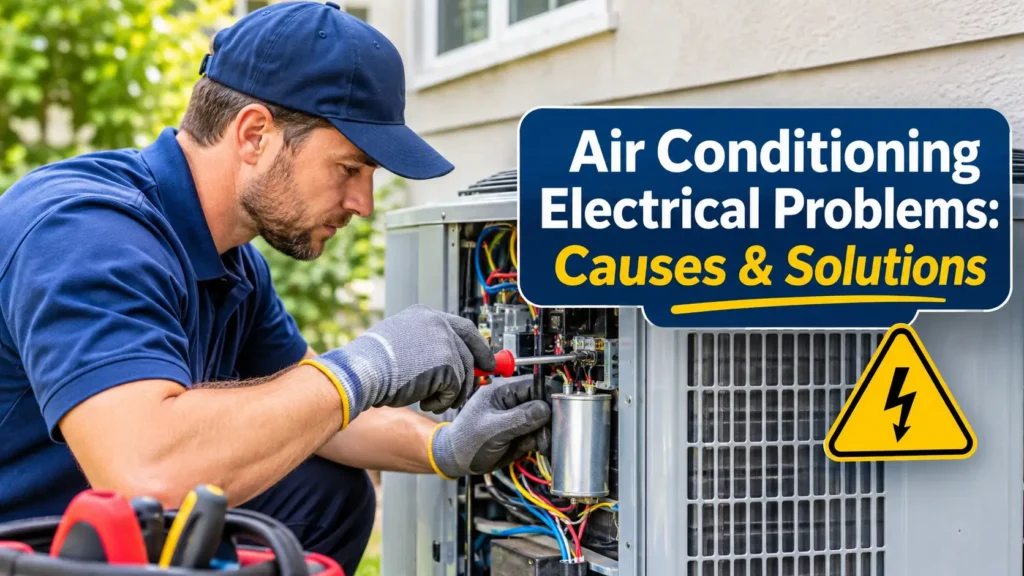
Air Conditioning Electrical Problems: Common Causes and Solutions
Air conditioning systems depend on a network of electrical components to operate correctly. When one of these components develops a fault, the entire system can become unreliable. You might notice that your AC refuses to switch on, repeatedly trips the circuit breaker, produces unusual buzzing sounds or suddenly stops cooling your property.
Some electrical problems are relatively straightforward to identify, while others involve internal components that require specialist testing. Ignoring the warning signs can lead to further equipment damage and, in serious cases, create an electrical fire or shock hazard.
Understanding the most common air conditioning electrical problems can help you recognise what might be wrong, avoid unsafe troubleshooting and decide when professional assistance is necessary. Here are the faults worth knowing about.
What Are Air Conditioning Electrical Problems?
Air conditioning electrical problems occur when the power supply, wiring, control circuits or electrical components inside an air conditioning system fail to operate as intended.
An air conditioner needs a stable electrical supply to operate its compressor, indoor fan, outdoor fan, control board and other components. A fault in even one part of this system can interrupt normal operation.
Electrical issues can affect different types of equipment, including:
- Split air conditioning systems
- Multi-split air conditioning units
- Central air conditioning systems
- Ducted air conditioning
- Commercial HVAC equipment
- Inverter air conditioning systems
The symptoms are not always obvious. For example, an air conditioner that runs but does not cool properly may have an electrical problem affecting its compressor or outdoor fan rather than a refrigerant issue.
8 Common Air Conditioning Electrical Problems
1. Tripped Circuit Breaker
A tripped circuit breaker is one of the most noticeable electrical problems affecting air conditioning equipment.
The circuit breaker is designed to interrupt the electricity supply when it detects an overload or certain types of electrical faults. This protects the electrical installation and connected equipment from potentially dangerous conditions.
If your air conditioner repeatedly trips the breaker, several problems could be responsible:
- An electrical short circuit.
- An overloaded electrical circuit.
- A damaged compressor or fan motor.
- Faulty internal wiring.
- A failing capacitor.
- An electrical component drawing excessive current.
For example, an air conditioning unit may operate normally for several minutes before suddenly switching off and tripping the breaker. This could indicate a component that begins drawing excessive current as it heats up.
What should you do?
Switch the air conditioner off. If the breaker has tripped, do not repeatedly reset it. A repeated trip indicates that the underlying problem needs investigation. Arrange an inspection by a qualified professional.
Never replace a breaker with one carrying a higher current rating simply to stop it tripping.
2. Faulty Capacitor
Capacitors play an important role in many conventional air conditioning systems. They help electric motors start and, depending on the design, continue running efficiently.
A faulty capacitor can prevent the compressor or fan motor from starting correctly.
Common warning signs include:
- The outdoor unit makes a humming noise but does not start.
- The fan struggles to rotate.
- The compressor repeatedly attempts to start.
- The air conditioner switches off unexpectedly.
- Cooling performance becomes inconsistent.
A capacitor can deteriorate over time because of heat, electrical stress and normal component ageing.
One important detail is that a humming outdoor unit does not automatically mean the capacitor has failed. A faulty contactor, motor problem or compressor fault can produce similar symptoms.
What should you do?
A technician should test the capacitor against its specified electrical rating and replace it if necessary. Capacitors can retain a dangerous electrical charge even after the system has been switched off, so they should never be handled by an untrained person.
3. Damaged or Loose Electrical Wiring
Electrical wiring connects the different parts of an air conditioning system and delivers the power required for operation.
Over time, wiring can become damaged through heat exposure, vibration, corrosion, physical damage or poor installation.
Loose connections are particularly problematic because they can create electrical resistance and localised overheating.
Possible symptoms include:
- Intermittent operation.
- Unusual buzzing or crackling sounds.
- Burning smells.
- Unexpected shutdowns.
- Discoloured electrical terminals.
- Repeated circuit breaker trips.
Consider an outdoor air conditioning unit exposed to years of vibration and changing weather conditions. A connection that was initially secure may deteriorate over time, creating an intermittent electrical fault.
What should you do?
Turn the system off if you suspect damaged wiring, especially if there is a burning smell, visible damage or unusual electrical noise. Do not open electrical enclosures or attempt to tighten connections yourself. A qualified technician should inspect and test the affected circuit.
4. Faulty Contactor
A contactor is an electrically controlled switch used in certain air conditioning systems to control power to components such as the compressor and outdoor fan motor.
When the thermostat or control board requests cooling, the control circuit activates the contactor, allowing the relevant components to operate.
A worn or damaged contactor can interrupt this process.
Typical symptoms include:
- The outdoor unit does not start.
- The air conditioner clicks but fails to operate.
- The compressor receives no power when cooling is requested.
- The system operates intermittently.
- The contactor produces unusual buzzing.
Contactors can deteriorate because of repeated electrical switching, heat and wear on their internal contacts.
A contactor that fails to operate correctly may prevent the compressor from starting even when the indoor unit appears to be working normally.
What should you do?
A professional can inspect the contactor, test its control voltage and check whether its contacts are operating correctly. Replacement may be necessary if the component is damaged.
5. Compressor Electrical Failure
The compressor is one of the most important components in an air conditioning system. It circulates refrigerant through the cooling circuit, allowing heat to be transferred away from the indoor environment.
Electrical problems affecting the compressor can prevent the system from cooling properly or stop it from operating altogether.
Possible causes include:
- Damaged compressor motor windings.
- Electrical insulation failure.
- A short circuit within the compressor.
- Overheating.
- Failed starting components.
- Loose electrical connections.
A common warning sign is an outdoor unit that repeatedly attempts to start but shuts down shortly afterwards.
In some situations, the compressor may make a humming noise before its internal thermal protection interrupts operation.
It is important to distinguish an electrical compressor fault from a mechanical compressor failure. Both can produce similar symptoms, but the correct repair depends on accurate testing.
What should you do?
A qualified air conditioning technician should assess the compressor’s electrical condition, operating current and associated components. Compressor replacement is not always necessary; sometimes the actual problem lies in a capacitor, contactor or wiring connection.
6. Faulty Fan Motor or Motor Capacitor
Both indoor and outdoor air conditioning units rely on fans to move air through the system.
The indoor fan circulates conditioned air around the property, while the outdoor fan helps release heat from the refrigerant circuit.
When a fan motor develops an electrical fault, the system may struggle to maintain the correct operating conditions.
Common symptoms include:
- The indoor unit produces little or no airflow.
- The outdoor fan does not rotate.
- The motor makes humming or grinding noises.
- The air conditioner overheats or shuts down.
- Cooling performance gradually deteriorates.
A failed fan motor capacitor may prevent a compatible motor from starting, while damaged motor windings can cause more serious operating problems.
An outdoor fan that stops working can also contribute to excessive system pressure and compressor overheating.
What should you do?
Switch the system off if a fan motor appears to have stopped working unexpectedly. A technician should inspect the motor, capacitor, electrical connections and associated controls.
Never attempt to push a fan blade to make it start.
7. Thermostat or Control Board Problems
Modern air conditioning systems rely on electronic controls to manage temperature, operating modes, fan speeds and safety functions.
The thermostat communicates the demand for heating or cooling, while the control board coordinates the operation of different components.
If either develops a fault, the air conditioner may behave unpredictably.
Common symptoms include:
- The display is blank or unresponsive.
- The system ignores temperature adjustments.
- The air conditioner starts and stops unexpectedly.
- The indoor unit works but the outdoor unit does not.
- Incorrect operating modes appear.
- The system displays an error code.
However, a blank thermostat does not necessarily mean the thermostat itself is faulty. A power supply issue, blown fuse, wiring fault or control transformer problem could also be responsible.
What should you do?
Check the thermostat settings and replace its batteries if the model uses them. If the problem continues, professional testing may be required to identify whether the fault is in the thermostat, control wiring, power supply or electronic control board.
8. Low Voltage or Unstable Electrical Supply
Air conditioning equipment is designed to operate within specific electrical supply limits.
If the incoming voltage is too low, too high or unstable, the system may struggle to start or operate correctly.
Potential symptoms include:
- Difficulty starting the compressor.
- Unusual motor noises.
- Repeated system shutdowns.
- Intermittent cooling.
- Electronic error codes.
- Protective shutdowns during periods of high electrical demand.
Voltage problems can originate from the property’s electrical installation, a faulty connection, an unsuitable circuit or an issue with the external electricity supply.
In properties where several high-demand appliances operate simultaneously, an inadequate electrical installation may also contribute to supply problems.
What should you do?
Do not attempt to compensate for low voltage by changing the circuit breaker or modifying the electrical supply. A qualified electrician or appropriately competent air conditioning professional should measure the supply and establish whether the problem originates within the property or the wider electrical network.
How to Recognise an Electrical Fault in Your Air Conditioner
Different electrical faults can produce similar symptoms. However, recognising the behaviour of your air conditioning system can help narrow down the possible cause.
| Symptom | Possible Electrical Cause |
|---|---|
| AC will not switch on | Power supply, fuse or control fault |
| Circuit breaker repeatedly trips | Overload, short circuit or damaged component |
| Outdoor unit hums but does not start | Capacitor, contactor or compressor fault |
| Indoor fan works but outdoor unit does not | Outdoor power, contactor or control fault |
| Air conditioner switches off unexpectedly | Overheating, electrical protection or control fault |
| Burning smell near the unit | Overheated wiring or electrical component |
| Fan does not rotate | Motor, capacitor or wiring fault |
| Thermostat display is blank | Power supply, batteries or control wiring |
These are diagnostic clues, not definitive diagnoses. A technician must test the system to identify the actual fault.
Electrical Problems in Inverter Air Conditioning Systems
Inverter air conditioning systems use electronic components to regulate compressor speed rather than simply switching the compressor on and off at a fixed speed.
This technology helps the system adjust its cooling output according to demand.
However, inverter systems have additional electrical components that can develop faults, including:
- Printed circuit boards (PCBs).
- Power modules.
- Inverter drives.
- Voltage sensors.
- Electronic communication circuits.
- Temperature sensors.
A faulty inverter board may cause the system to stop operating, display an error code or repeatedly enter a protective shutdown mode.
Another important consideration is that inverter equipment can involve high-voltage DC circuits and capacitors that retain electrical energy after the power has been disconnected.
For this reason, diagnosing inverter electrical problems requires appropriate training, manufacturer-specific procedures and suitable testing equipment.
Are Air Conditioning Electrical Problems Dangerous?
Yes. Some electrical faults can create serious safety risks if they are ignored.
The most important warning signs include:
Burning smells: This may indicate overheating insulation, loose electrical connections or a failing component.
Repeated breaker trips: A protective device that repeatedly disconnects the supply should never be bypassed or treated as an inconvenience.
Sparks or visible arcing: These indicate a potentially serious electrical fault.
Electric shocks or tingling sensations: Stop using the equipment immediately and arrange an urgent professional inspection.
Water near electrical components: Water ingress can increase the risk of electric shock, short circuits and equipment damage.
If you notice smoke, fire or active sparking, keep away from the equipment and call emergency services when necessary.
The UK Health and Safety Executive (HSE) advises that electrical equipment and supplies must be suitable for their intended use and that RCD protection should not be treated as a substitute for proper electrical safety measures.
What Can You Safely Check Before Calling an Air Conditioning Technician?
Homeowners can carry out a few basic external checks without opening the air conditioning equipment.
- Check the thermostat: Make sure the cooling mode and temperature settings are correct.
- Check the remote control: Replace the batteries if the display is weak or unresponsive.
- Look at the consumer unit: Check whether a relevant circuit breaker or RCD has tripped. Do not repeatedly reset it.
- Inspect the external area: Look for obvious obstructions around the outdoor unit without removing protective covers.
- Check for visible warning signs: Burning smells, smoke, damaged cables or water around electrical equipment require the system to be switched off if this can be done safely.
Never remove electrical covers, test live wiring, replace internal fuses, discharge capacitors or attempt to repair electrical connections without the necessary competence.
Common Mistakes That Can Make Electrical Problems Worse
Some seemingly simple actions can turn a minor fault into a more expensive repair.
Repeatedly Resetting the Circuit Breaker
A breaker trips because a protective device has detected an abnormal condition. Repeatedly resetting it without investigating the cause can expose the equipment and electrical installation to further risk.
Ignoring Unusual Sounds
Buzzing, crackling and repeated clicking can indicate electrical or component problems. These sounds should not automatically be dismissed as normal operating noise.
Using the Wrong Fuse Rating
Installing a fuse with a higher rating than specified by the manufacturer can compromise the protection designed into the system.
Attempting DIY Capacitor Replacement
Air conditioning capacitors can retain hazardous electrical energy. Switching off the system does not automatically make every internal component safe to touch.
Assuming Every Cooling Problem Is a Refrigerant Issue
Poor cooling can result from a failed fan motor, faulty contactor, compressor electrical problem or control board fault. Adding refrigerant without proper diagnosis will not resolve an underlying electrical issue.
When Should You Arrange Professional Air Conditioning Repair?
Professional inspection is recommended whenever an air conditioner repeatedly loses power, trips a protective device, produces electrical noises or shows signs of overheating.
You should seek urgent assistance if you notice burning smells, visible sparks, smoke, damaged electrical cables or electric shocks.
A professional diagnostic inspection may involve:
- Checking the incoming electrical supply.
- Measuring voltage and current.
- Inspecting wiring and electrical connections.
- Testing capacitors and contactors.
- Checking compressor and fan motor operation.
- Examining control boards and error codes.
- Testing relevant safety devices.
The exact diagnostic process depends on the equipment type, manufacturer and symptoms.
For UK properties, electrical work should be carried out by someone with the appropriate competence. Refrigerant-related work is a separate area and may require an appropriately qualified F-gas engineer.
Frequently Asked Questions
1. Why does my air conditioner keep tripping the circuit breaker?
Repeated breaker trips may be caused by an overloaded circuit, damaged wiring, a failing capacitor, a faulty motor or a compressor electrical fault. Stop using the system and arrange a professional inspection rather than repeatedly resetting the breaker.
2. Can a faulty capacitor stop an air conditioner from working?
Yes. A failed capacitor can prevent compatible compressor or fan motors from starting correctly. You may hear humming or clicking without the unit operating normally.
3. Why is my AC running but not cooling?
Possible causes include a compressor electrical fault, a malfunctioning outdoor fan, a control problem or a refrigerant issue. Proper diagnosis is necessary because several faults can produce the same symptom.
4. Is it safe to use an air conditioner with electrical problems?
Not always. If you notice burning smells, sparks, repeated breaker trips, damaged cables or electric shocks, stop using the equipment and arrange professional assistance.
5. How much does it cost to repair an air conditioning electrical fault in the UK?
The cost depends on the faulty component, the system type, the time required for diagnosis and whether replacement parts are needed. A loose connection, capacitor fault and compressor failure can involve very different repair costs. Request a diagnosis and quotation before authorising the work.
6. Can regular air conditioning maintenance prevent electrical faults?
Regular maintenance can help identify deteriorating connections, overheating components, damaged wiring and other developing problems before they cause a breakdown. However, maintenance cannot guarantee that electrical components will never fail.
Final Thoughts
Air conditioning electrical problems can affect everything from the thermostat and control board to the compressor, fan motors and main power supply.
The most important thing is to recognise the warning signs early. Repeated circuit breaker trips, unusual electrical noises, burning smells and unexpected shutdowns should never be ignored.
Start with simple external checks, but leave internal electrical testing and repairs to appropriately qualified professionals.
If your air conditioning system is not operating reliably, arranging a professional inspection can help identify the underlying fault, prevent unnecessary component replacement and restore safe, dependable operation.